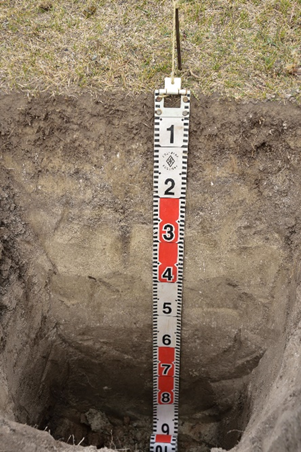
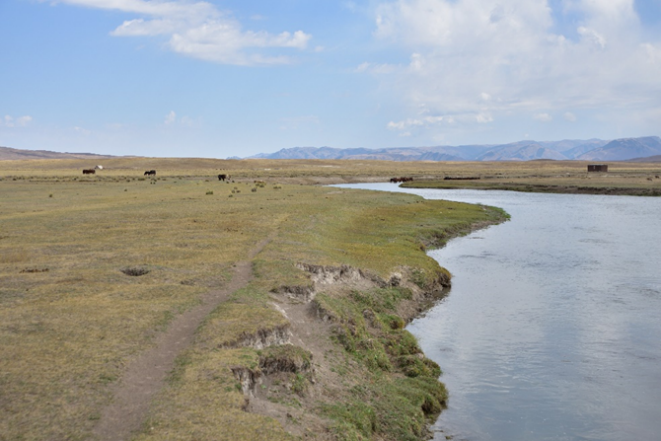
Eight soil sections were laid, georeferenced using GPS, a description of the relief, vegetation, as well as the morphological structure of soil profiles by genetic horizons, including the characteristics of color, moisture, compaction of the structure, and mechanical composition of the soil (shown below) were carried out. Photographs of soil profiles and their corresponding landscapes were taken. Soil samples were selected for further chemical analyses.
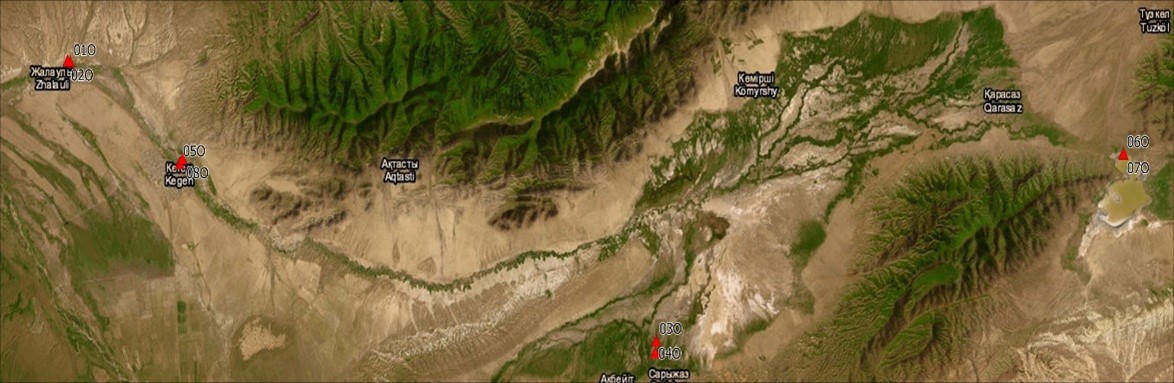
Location of soil sections in the places where kok-saghyz grows
Sampling and chemical analysis of soils
— Soil samples were collected and chemical analyses of 41 soil samples were conducted in the Kok-Sagyz growing areas and 16 samples in the foothill plain of Zailiisky Alatau.
— The following types of analyses were conducted: humus, gross nitrogen, CO2, pH, absorbed Ca, Mg, Na, K, nutrients (N, P, K), amount and composition of salts, mechanical (granulometric) composition of soils, microelements.
— Territories on foothill plain of Zailiisky Alatau have been surveyed for the choice of sites for laying of experiments in situ, and also carrying out of model experiments in Institute where 3 soil cuts have been put in the areas of approximate conditions of growing kok-sagyz with sampling for chemical analyses, and also the soil in an amount of 75 kg for statement of experiments in Institute.
— Conclusion
— It was established that kok-sagyz grows in sity in conditions of floodplains of intermountain valleys on strongly saline floodplain meadow soils of sulphate-sodium composition with high content of humus (3-9 %) and in alkaline environment (рН = 8,8 — 9,6) and very high content of nutrients (N, P, K).
Problem 2: Organization of a field genebank of T. kok-saghyz species under in situ conditions.
Reintroduction of T. kok-saghyz to organize a field genebank under in situ conditions.
Publications (2022):
- Bari GT, Zhanbyrbaev EA, Jantasov SK, Uteulin KR Identification and production of inulin from the roots of kok-saghyz (Taraxacum kok-saghyz Rodin) // 3i: intellect, idea, innovation. Kostanay Regional University named after Akhmet Baitursynov. №3. 2022. — С. 79-85. KKSON MNVO RK.
Results for 2023-2024:
For the first time, a field gene bank for kok-saghyz has been established in its natural habitat in the intermountain valleys of the Tien Shan in Kazakhstan. The current state of the soils in the kok-saghyz natural habitat area has been studied. The in situ field gene bank of kok-saghyz has been created specifically as a source of elite seeds to replenish Kazakhstan and international ex situ gene banks, research, breeding programs, and other consumers. The in situ seed productivity of the kok-sagyz genebank is 21,600 seeds per year. Seeds were sent to scientific centers. Data on the in situ genebank is documented. To increase the productivity of the introduced kok-sagyz, a technology for obtaining a complex fertilizer has been developed.
The in situ field gene bank of kok-saghyz is an implemented technological innovation ensuring the conservation and use of Kazakhstan’s genetic resources of kok-saghyz, a method of protecting this rare species included in the Red Book. Convention on Biological Diversity Goals: The project has achieved the goals of the Convention on Biological Diversity: conservation of biological diversity and sustainable use of its components. The benefits of using genetic resources may include monetary and non-monetary benefits. The project’s research results have been applied to address scientific and technological development tasks of the Republic of Kazakhstan.
Publications (2023-2024):
- Uteulin K., Suleimenov B., Pachikin K. The Soils of Natural (In Situ) Coenopopulations of Taraxacum kok-saghyz L.E. Rodin in Kazakhstan. Agronomy 2023, 13(11), 2737; https://doi.org/10.3390/agronomy13112737. Published: 30 October 2023, Q1, percentile 84.
- Bulat Kuluev, Kairat Uteulin, Gabit Bari, Elvina Baimukhametova, Khalit Musin, Alexey Chemeris. Molecular Genetic Research and Genetic Engineering of Taraxacum kok-saghyz L.E. Rodin. 2023, 12(8), 1621; https://doi.org/10.3390/plants12081621 (registering DOI). Q 1. percentile 86.
- Uteulin K. Kazakh populations of kok—sagyz dandelion (Taraxacum kok-saghyz L.E. Rodin). «Bulletin of the Karaganda University. Series «Biology, medicine, geography«». – 2023. – Vol.2, №110. – Р. 151- 161. https://doi.org//10.31489/2023BMG2/.
- Uteulin K. Seed germination and seedling development of rubber dandelion kok-saghyz (Taraxacum kok-saghyzE. Rodin) on soil samples in situ populations: «Salt Lake», «Saryzhaz», «Kegen». «Bulletin of the Karaganda University. Series «Biology, medicine, geography«». – 2023. – № 3. – Р. 196-205. https://doi.org// 10.31489/2023BMG3/196-205.
- Patent RK for Invention №36776, 10.2024 «Method of pre-sowing treatment of kok-sagyz seeds (Taraxacum kok-saghyz L.E. Rodin)». Authors: Bari G.T., Uteulin K.
- Uteulin K. The monograph «Kok sagyz. The current state. Introduction to culture«. – 2024. — Аlmaty, Zhebe-design. – 120 р.