Brief description of the project
(2024-2026)
Project title: IRN AP23488116 « Study of saponin-bearing plants (fam. Caryophyllaceae) from the Kazakhstan flora to create new bactericidal and fungicidal biological plant protection products».
Relevance. The development of organic production provides for the use of biological agents or biopesticides for plant protection, which meet international requirements of safety for humans and the environment. The protective role of saponins against a wide range of pathogens and their high biological activity allow considering them as a promising natural basis for obtaining biopesticides. The unique flora of Kazakhstan includes exceptional saponin-bearing plants for the creation of domestic biopesticides based on natural protective compounds.
The goal of the project: to study antibacterial and antifungal properties of promising saponin-bearing plants of local flora and to develop a scientific and methodological basis for the creation of new domestic biological plant protection products on their basis.
Expected results:
1) scientific and methodological basis for the creation of new domestic biological plant protection products based on saponin-bearing plants of Kazakhstan flora;
2) prototypes of effective phytoextracts with bactericidal and fungicidal action;
3) Scientific and methodological recommendations on the study and application of biopesticide properties of saponin-bearing plants — natural sources of new environmentally safe plant protection products;
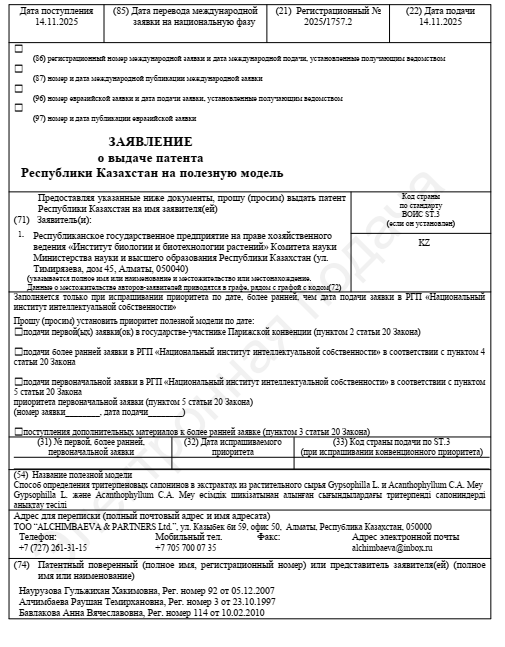
4) patent for the method of obtaining saponin extracts with bactericidal and fungicidal action.
Scientific Supervisor of the project:
Valentina Mursaliyeva, leading researcher of IPBB, Candidate of biol. Sc. (Ph.D.), chief specialist in the field of plant physiology and biochemistry. Mursaliyeva V. K. was scientific supervisor of 8 applied projects (2000 — 2023), principal investigator within the framework of the scientific-technical programs of the IRPH “Phytochemistry” (2012-2014), Mangyshlak Experimental Botanical Garden (2018-2020), Institute of Botany and Phytointroduction (2021). The author has published: 6 methodological recommendations, 12 innovative patents of the Republic of Kazakhstan, more than 85 publications, including 9 articles in referred international journals listed in Web of Science and Scopus database (https://app.webofknowledge.com/author/record/12173077,41802049, H-index 3, Scopus Author ID: 55428004100, ORCID ID: 0000-0003-4803-9169).
Research group:
Dr. Nadezhda Gemejiyeva, leading research scientist, Doctor of biol. Sci., professor, has more than 80 publications, including 12 foreign articles in rating journals listed in Web of Science (Researcher ID: AAQ-4741-2020, H-index 5) or/and Scopus database (Author ID: 55498326000).
Dr. Gulnar Dzhakibayeva, leading research scientist, Candidate of biol. Sci., has more than 50 publications, including article in rating journals listed in Web of Science (Researcher ID: JQT-8300-2023, H-index 1, ORCID 0000-0001-9662-6531).
Dr. Svetlana Turasheva, senior research scientist, Candidate of biol. Sci., has more than 70 publications, including 2 monographs, 8 educational and methodical publications, 3 patent RK, 7 foreign articles in rating journals listed in Web of Science or/and Scopus database (Researcher ID: AAE-9759-201, Scopus Author ID 57205564813, H-index 4, ORCID 0000-0001-9983-8601).
Ms. Horlan Berkimbay, researcher, has 15 publications, including 5 articles in the journals of CQAES of the Ministry of Education and Science of the Republic of Kazakhstan, 2 foreign articles in rating journals listed in Web of Science or/and Scopus database (Researcher ID: ААР-8113-2020, H-index 2, ORCID 0000-0003-2566-8536).
Ms. Tlek Mukhanov, researcher, has 7 publications, including 2 patents of RK, 3 foreign articles in rating journals listed in Web of Science or/and Scopus database (H-index 2, ResearcherID: JCO-2629-2023, Scopus Author ID 58193281000, ORCID 0000-0002-7590-769X).
Ms. Akmaral Algazy, junior researcher, has 4 publications, including patent of RK, article in rating journal (Q2), listed in Web of Science or/and Scopus database (Researcher ID: IRH-4322-2023, H-index 1, ORCID 0000-0001-5883-9800).
List of publications of the project’s participants (2018-2023)
- Mursaliyeva V.K., Sarsenbek B.T., Dzhakibaeva G.T., Mukhanov T.M., Mammadov R. Total content of saponins, phenols and flavonoids and antioxidant and antimicrobial activity of in vitro culture of Allochrusa gypsophiloides(Regel) Schischk compared to wild plants // Plants Basel, 2023, 12 (20), Web of Science (WOS) i.f. 4,5, Q1, Scopus pr. 83. https://doi.org/10.3390/plants12203521
- Mursaliyeva V., Algazy A., Satybaldiyeva D., Mukhanov T.Obtaining of adventitious roots culture of Allochrusa gypsophiloides: saponins-bearing endemic rare species // Plant Biotechnology Reports, 2023, 17(3), 421-425. WOS i.f. 2,4, Q2, Scopus pr. 69. https://doi.org/10.1007/s11816-023-00836-7
- Mursaliyeva V.K., Mukhanov T.M., Gemejiyeva N.G., Yeskaliyeva B.K. Chemical analysis and biological activity of Turkestan soaproot Allochrusa gypsophiloides (Regel) Schischk growing in the south of Kazakhstan// Khimiya Rastitel’nogo Syr’ya. 2023, N.3, 183-191. Scopus pr. 10 Q4. DOI: 10.14258/jcprm.20230311993.
- Mursaliyeva V.K., Algazy A.T., Satybaldiyeva D.N., Mukhanov T.M. Adventitious root in vitro cultures of Turkestan soaproot Allochrusa gypsophiloides (Regel) Schischk. // Experimental biology, 2023, 94(1), 25-39. URL: https://doi.org/10.26577/eb.2023.v94.i1.03
- Mursalıyeva V., Algasy A., Mukhanov T., Mammadov R. & Gemejiyeva N. Quantitative Determination of Metabolites of Turkestan Soaproot (Allochrusa gypsophiloides (Regel) Schischk.) Grown in Kazakhstan. International Journal of Nature and Life Sciences, 2022, 6 (2), 129-141.URL: https://doi.org/10.47947/ijnls.1180197
- Mursaliyeva V., Imanbayeva A., Parkhatova R. Seed germination of Allochrusa gypsophiloides (Caryophyllaceae), an endemic species from Central Asia and Kazakhstan. Seed Science and Technology, 2020, 48(2):289-295. WOS i.f. 0,5, Q4, Scopus pr. DOI: https://doi.org/10.15258/sst.2020.48.2.15
- Mursaliyeva V., Imanbayeva A. Micropropagation of Turkestan Soap Root Allochrusa gypsophiloides – natural source of saponins. International Journal of Secondary metabolite, 2020, 7(1):1-7. https://doi.org/10.21448/IJSM.627140
- Zhumaliyeva G, Zhussupova A, Zhusupova GE, Błońska-Sikora E, Cerreto A, Omirbekova N, Zhunusbayeva Z, Gemejiyeva N, Ramazanova M, Wrzosek M, et al. Natural Compounds of Salvia Genus and Molecular Mechanism of Their Biological Activity. Biomedicines. 2023; 11(12):3151. WOS i.f. 3,9, Q2, Scopus pr. 74, https://doi.org/10.3390/biomedicines11123151.
- Dzhakibayeva G., Sadanov A., Ismailova Е., Baimahanova B., Molzhigitova А., Baimahanova G., Shemshura O., Tleubekova D., Elubaeva А. Evaluation of the inhibitory activity of collection yeast cultures against the causative agent of bacterial burn Erwinia amylovora. Microbiology and Virology, 2023, 2(41), 173–182. https://doi.org/10.53729/MV-AS.2023.02.11.
- Patent RK № 7649 for the utility model. Method of obtaining of adventitious roots culture of the Turkestan soap root Allochrusa gypsophiloides in vitro conditions. Mursaliyeva V.K., Algasy A.T., Mukhanov T.M.., Sarsenbek B.Т.
Results for 2024:
A botanical analysis of the current state of natural populations of saponin-containing species (fam. Caryophyllaceae) during expeditionary surveys in the Balkhash and Enbekshikazakh districts of the Almaty region has been carried out. Natural populations of 3 species of the genera Acanthophyllum C. A. Mey. and Gypsophila L have been identified in a desert area in the vicinity of Konaev and the village. Bakbakty, in the vicinity of the Bartogai reservoir and the foothill plain of the Bala Boguty mountains. Gypsophila paniculata and G. perfoliata are small groups within the whole-leaved flax and karelinium-grain-sophora communities. The population of A. pungens in the foothill valley of the Bala Boguta Mountains is a saxaul-thorn-wormwood community (0.9 ha) with a raw material reserve density of 0.2 specimens/m2. The coordinates of the locations were determined and the phytocenotic characteristics of the populations were given, samples of seeds and initial plant raw materials were collected. The first assessment of saponin content in wild species G. paniculata, G. perfoliata and A.pungens growing in the Almaty region, have shown their promise as sources of triterpene saponins of the β-amyrin series in the following order: A.pungens > G.perfoliata > G.paniculata. The greatest amount of saponins (up to 27%) is in the roots of A. pungens at the end of the vegetation; in G. perfoliata — at the stage of flowering- fruiting, in the roots of 14% — 24%, in the flowering aboveground — 12.7%; in large roots of G. paniculata — up to 14%, fruiting. Optimal timing for harvesting raw materials: underground organs — end of August-September, fruiting phase-end of vegetation, aboveground part – July-August, flowering.
Publications (2024):
Mursaliyeva V.K., Mukhanov T.M. Adventitious roots culture of Allochrusa gypsophiloides: saponins-bearing rare species // The International conference of Plant Biology and Biotechnology. Almaty, 3-6 June 2024, p. 159. https://primerdigital.com/ICPBB2024/files/ABSTRACTS_BOOK.pdf
Mursaliyeva V.K., Mukhanov T.M. Establishment of in vitro culture and chemical composition of hexane extract of callus and regenerants of Niedzwedzkia semiretschenskia // 7th Symposium of Euroasian biodiversity. Erzurum Türkiye, 22-24 August, 2024, p.130. https://seabsymp.com/en/abstract-book/
Nurzhanova A.A, Mamirova A., Mursaliyeva V., Nurmagambetova A., Zhumasheva Z., Turdiyev T., Kushnarenko S., Ismailova E. In Vitro Approbation of Microbial Preparations to Shield Fruit Crops from Fire Blight: Physio-Biochemical Parameters //Plant Basel, 13 (11): 1431. WOS, Q1, процентиль Scopus 85. https://doi.org/10.3390/plants13111431.
Results for 2025
Phytochemical analysis of plant materials of Gypsophilla paniculata, Gypsophilla perfoliata, and Acanthophyllum pungens collected from natural populations was conducted. The content of the main natural compounds identified by qualitative reactions in the original raw materials was determined.The saponin content in the extracts varied: G. paniculata — 16%-23%, G. perfoliata — 12%-28%, A. pungens — 12%-30% depending on the vegetation phase and plant part. The content of phenolic substances between species did not differ significantly, within 0.15%-0.20% during the vegetation stage, increasing their level to 0.63%-1.08% by the end of the growing season. The maximum amount of flavonoids in the roots accumulated towards the end of the growing season and varied: G. paniculata – 0.35%, A. pungens and G. perfoliatа – up to 0.65%. High amounts of flavonoids were found in extracts from the above-ground parts of plants at the flowering stage, up to 2.75%. Total extracts with a predominance of saponins were obtained, their qualitative and quantitative characteristics are given. The UV absorption spectrum of quillaic acid (QA) and sapogenins of the extracts of G. paniculata, G. perfoliatа, and A. pungens have one absorption maximum: at λ 320 nm for the products of their interaction with sulfuric acid, at λ 440 nm for the reaction with vanillin and sulfuric acid. The HPLC results confirmed the predominance of QA derivatives in the extracts. Triterpene saponins of the β-amyrin series, derivatives of oleanolic acid, were detected in hydrolyzed extracts using TLC.
The growth-inhibitory activity of ethanol extracts (10:1) was assessed in in vitro model test systems of fungi (Fusarium ssp., Aspergillus ssp.) and bacteria (Agrobacterium sp., Erwinia amylovora, Bacillus megathericum, Bacillus subtilis) using the diffusion method. An antagonistic effect of the saponin extracts (250 μl dose) was observed: against Bacillus ssp. at the control level; against Erwinia amylovora and Agrobacterium sp. with a 30% excess of the control. Antifungal activity was detected in extracts from the roots of Gypsophilla L. and A. pungens against Fusarium ssp. and Aspergillus ssp. High cytotoxic activity of saponin extracts from roots was detected, with an LC50 of 63 μg/mL. An optimized method for extracting saponins from promising plant includes an additional step of treating the ethanol extract with acetone to reprecipitate the saponins and remove associated substances.
Information for potential users
Extracts from plant materials of Gypsophilla paniculata, Gypsophilla perfoliata and Acanthophyllum pungens with a high content of triterpene saponins and antimicrobial and cytotoxic activity were obtained.
Publications 2025
Abstracts of the international conference (indicating the form of the report )
Mursaliyeva V.K., Gemejiyeva N.G., Dzhakibayeva G.T., Mukhanov T.M., Sarsenbek B.T., Algazy A.T. Saponin content in wild plants of Acanthophyllum C. A. Mey. and Gypsophila L. native to the Almaty region (Kazakhstan) // Proceeding of the 3RD International Symposium on the Frontiers of Plant Diversity Conservation Research in the Pan-Third Pole Region (PDCR 2025), August 26-29, 2025, Almaty, p. 63. (poster)
Sarsenbek B.T., Algazy A.T., Murzataeva T.Sh., Mukhanov T.M., Mursaliyeva V.K. Biotechnological Preservation Of Endemic Relict Niedzwedzkia Semiretschenskia B. Fedtsch // 3rd International Symposium on the Frontiers of Plant Biodiversity Conservation Research in the Pan-Third Pole Region (PDCR 2025) Kazakhstan, Almaty, August 26-29, 2025. – P.69 (poster)
Patent application
Mursaliyeva V.K., Mukhanov T.M., Algazy A.T., Sәrsenbek B.T., Gemedzhiyeva N.G. Method for determination of triterpene saponins in extracts from Gypsophilla L. and Acanthophyllum C.A. Mey. Reg. No. 2025/1757.2 from November 14, 2025.